English
 中文简体
中文简体 русский
 Français
 Español

Pallet Handling Equipment in the Modern Warehouse
Every warehouse, distribution center, or manufacturing floor moves the same basic unit of work: the loaded pallet. How that pallet gets from a delivery truck to a storage rack, and from a rack to an outbound dock, shapes labor cost, throughput, and worker safety more than almost any other operational decision. Three categories of equipment dominate this task: the manually powered hand pallet truck, the battery-driven electric pallet truck, and the vertically capable electric stacker. Each serves a distinct combination of load weight, travel distance, and lift height, and choosing incorrectly tends to show up quickly as bottlenecks, fatigue-related injuries, or wasted capital on equipment that is either underpowered or unnecessarily complex.
The three machines are often discussed together because they share a common footprint and a similar operating principle: forks slide under a pallet, a lifting mechanism raises the load clear of the floor, and an operator steers the unit to its destination. Where they diverge is in how the lift is powered, how far the load can travel without operator fatigue becoming a factor, and how high the load can be raised. A facility that only shuttles pallets across a level floor for short distances has very different needs from one that stacks inventory three or four levels high in a narrow-aisle rack system.
This guide breaks down the mechanical anatomy of each machine, compares their practical performance side by side, and provides a structured way to match equipment type to actual warehouse conditions rather than relying on guesswork or oversized purchases made out of caution.
Anatomy of an Electric Pallet Stacker
An electric stacker is built around a vertical mast that allows forks to lift a pallet well above floor level, typically into the range needed for the second or third rack beam in a standard pallet racking system. Unlike a pallet truck, which only moves loads horizontally, a stacker adds a controlled vertical axis, which means its design has to account for mast stability, load center of gravity, and battery placement as a counterweight.
1.png)
The core subsystems of a typical stacker are shown below. Understanding how they interact helps explain why lift capacity tends to drop as fork height increases, and why battery specification is not a minor afterthought but a determining factor in daily duty cycle.
The battery pack does double duty as ballast that offsets the forward weight of a raised, loaded pallet, which is why swapping to a lighter battery chemistry without adjusting mast geometry can affect stability at full lift height. The drive wheel and motor assembly determine travel speed and ramp-climbing ability, while the tiller arm houses the lift, lower, and travel controls the operator uses throughout a shift.
Rider platform variants, like the configuration shown above, add a small standing deck so the operator travels with the machine rather than walking alongside it, which becomes valuable once travel distances between pick and stage areas extend beyond roughly thirty meters per trip.
Electric Pallet Truck: Power for High-Frequency Horizontal Moves
An electric pallet truck keeps the same low-profile fork geometry as a manual unit but replaces manual pumping and pulling with a battery-driven hydraulic lift and a powered drive wheel. It does not raise loads to rack height the way a stacker does; instead, it lifts a pallet just enough to clear the floor, then relies on motorized propulsion to move the load across longer distances than a person could comfortably push or pull by hand.
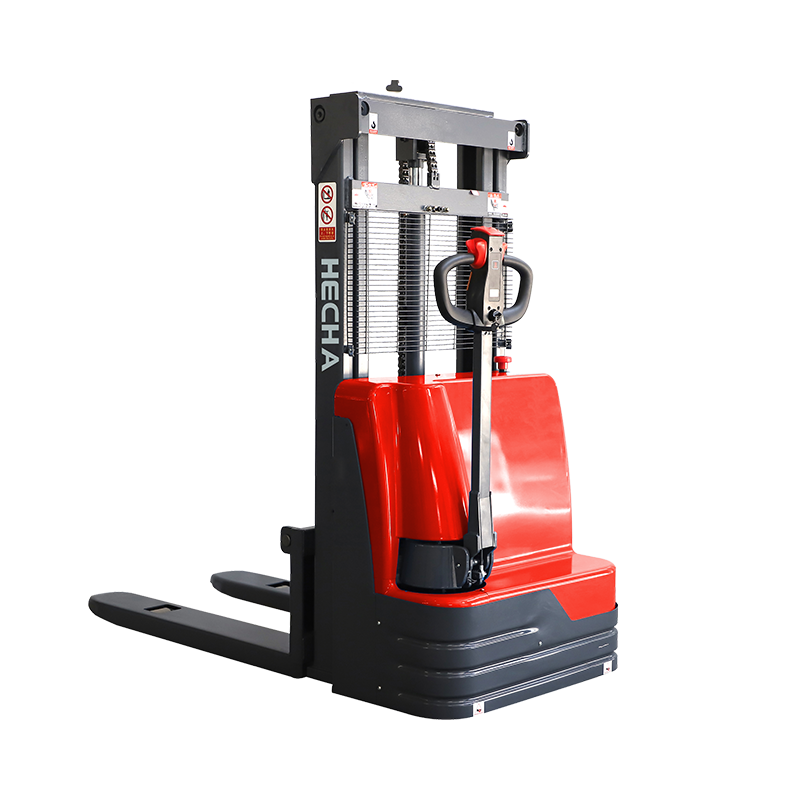
This category is often the answer when a facility has already outgrown hand-pushed equipment on the basis of distance and repetition, but does not yet need vertical stacking. Typical use cases include moving pallets from receiving to a staging lane, feeding a conveyor line, or shuttling between a dock door and a nearby storage zone.
Because the lift function is powered rather than manual, operator fatigue over a shift drops sharply compared with a hand pallet truck used for the same volume of moves. The trade-off is a higher upfront cost, a charging routine that has to be built into daily operations, and a wider turning footprint than an equivalent manual unit, which matters in tightly packed staging areas.
Hand Pallet Truck: Simplicity for Light and Occasional Duty
The hand pallet truck remains the most common piece of material handling equipment in existence because it has no battery to charge, no motor to service, and a mechanical simplicity that keeps both purchase price and maintenance cost low. A hydraulic pump operated by hand, worked through an up-and-down motion of the tiller handle, raises the forks enough to clear the pallet base, after which the operator pushes or pulls the load to its destination.
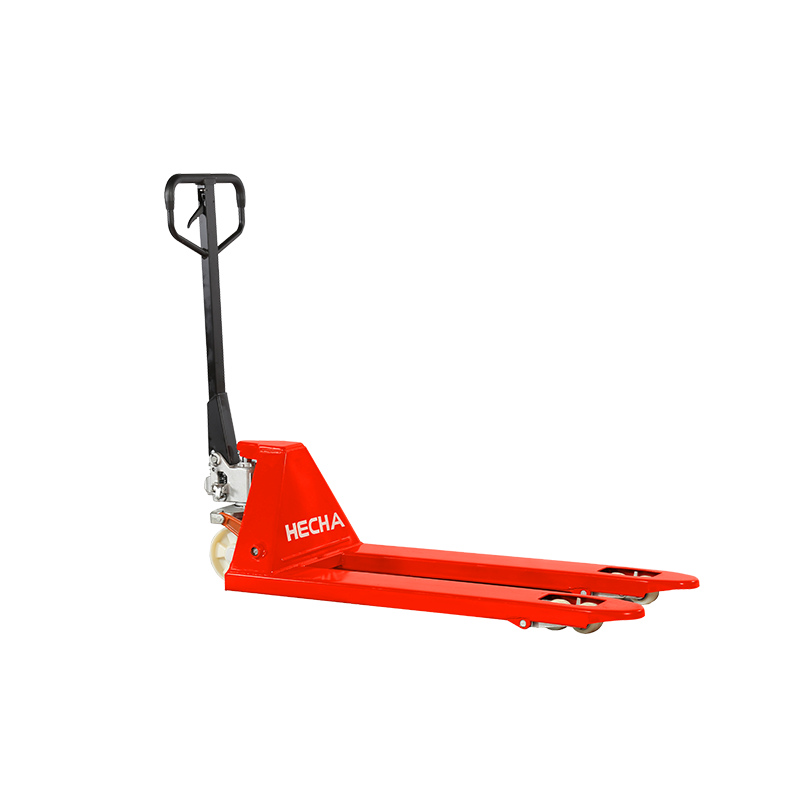
This equipment class suits environments where pallet moves are frequent but short, such as inside a retail stockroom, a small manufacturing cell, or a loading dock where pallets only need to travel a few meters before being picked up by other equipment. Rated capacities commonly range from 2000 to 5000 kg, which comfortably covers most standard pallet loads, though sustained use at the upper end of that range over long distances is where fatigue and repetitive strain become a genuine concern.
A hand pallet truck trades operator effort for equipment simplicity. It is the right tool when moves are short and occasional, and the wrong tool when moves are long and constant.
Because there is no battery or motor, uptime is rarely an issue outside of routine seal and wheel maintenance, which makes hand pallet trucks a dependable backup even in facilities that primarily rely on powered equipment.
Manual Versus Electric: A Side-by-Side Comparison
The table below summarizes the practical differences between the three equipment types across the factors that most commonly drive a purchasing decision.
| Factor | Hand Pallet Truck | Electric Pallet Truck | Electric Stacker |
|---|---|---|---|
| Vertical lift | Floor clearance only | Floor clearance only | Rack height, commonly 2 to 5 meters |
| Power source | Manual hydraulic pump | Battery-driven hydraulics and drive | Battery-driven hydraulics and drive |
| Typical rated capacity | 2000 to 5000 kg | 1500 to 3000 kg | 1000 to 2000 kg |
| Best travel distance | Short, occasional | Medium to long, frequent | Medium, repetitive with stacking |
| Maintenance load | Low | Moderate, battery and motor service | Moderate to high, mast and battery service |
| Operator fatigue over a shift | Higher | Lower | Lower |
A useful way to read this table is by identifying the single factor that most constrains current operations. Facilities constrained by aisle height and rack stacking gravitate toward a stacker regardless of cost, since neither pallet truck option can lift to rack level. Facilities constrained by labor hours on repetitive horizontal moves benefit most from an electric pallet truck. Facilities with genuinely light, occasional pallet movement often find that a hand pallet truck remains the most cost-effective option even after accounting for labor time.
A Decision Framework for Selecting the Right Equipment
Rather than starting from equipment features, it helps to start from three operational questions: how high does the load need to travel, how far does it need to travel horizontally, and how many times per shift does that move repeat. The flow below walks through this logic.
This framework deliberately leads with lift height because it is the only decision point that cannot be worked around with additional labor or a different operating procedure. If pallets must reach a second or third rack beam, no amount of horizontal maneuverability substitutes for a mast. Only once that question is answered does travel distance and frequency become the deciding factor between powered and manual horizontal movement.
It is also worth accounting for aisle width at this stage. Stackers and electric pallet trucks generally require a wider turning radius than hand pallet trucks of equivalent capacity, so a facility with narrow aisles may need to weigh a compact stacker model or a walkie configuration rather than a rider unit, even if lift height requirements point toward powered equipment.
Battery, Capacity, and Ergonomics Considerations
Once equipment category is decided, a few secondary specifications shape day-to-day performance and should not be treated as afterthoughts.
Battery Runtime and Charging Routine
Electric stackers and electric pallet trucks both depend on scheduled charging. A facility running a single shift typically has enough downtime overnight for a full charge cycle, while multi-shift operations may need either a battery swap routine or opportunity charging during breaks. Underestimating charging infrastructure is one of the more common causes of equipment sitting idle during peak demand.
Rated Capacity Versus Actual Load
Rated capacity figures assume the load center is positioned at the standard distance from the fork face, usually around 500 millimeters for a standard pallet. Loads with an off-center or extended center of gravity effectively reduce the safe working capacity below the nameplate rating, which is a common source of confusion when a machine appears to struggle with a load nominally within its rated limit.
Operator Ergonomics
Rider platforms and powered steering reduce physical strain over a shift, but they also require a slightly higher level of operator training and awareness of stopping distance, since powered units travel faster and carry more momentum than manually pushed equipment. Facilities transitioning from hand pallet trucks to powered alternatives generally see a drop in repetitive strain complaints, offset by a need for more structured operator certification.
- Match rated capacity to the heaviest routine load, not the average load
- Confirm charging infrastructure before committing to a powered fleet size
- Account for load center distance when comparing nameplate capacities
- Factor aisle width into stacker mast height and turning radius selection
Maintenance and Safety Practices
Regardless of equipment type, a small set of maintenance habits accounts for most of the difference between equipment that lasts for years and equipment that fails prematurely.
- Inspect forks and mast components for cracks or deformation before each shift
- Check hydraulic fluid levels and look for leaks around the lift cylinder
- Confirm wheel and caster condition, since worn wheels increase steering effort and reduce stability
- For powered units, verify battery terminal condition and charge status before use
- Test brake and lift-lower controls at the start of each shift, not only during scheduled service
Safety practices around pallet handling equipment center on load stability and pedestrian awareness. Loads should always be centered and secured before lifting, forks should be lowered fully before extended horizontal travel on a stacker, and operators should sound a warning at blind corners or intersections, particularly with rider-configured units traveling at higher speed than a walk-behind machine.
Most pallet handling incidents trace back to two causes: an off-center load and a machine traveling faster than the aisle conditions warrant. Both are preventable through routine, not equipment upgrades.
Frequently Asked Questions
Q1: What is the main difference between a pallet stacker and a pallet truck?
A pallet stacker has a vertical mast that lifts loads to rack height, while a pallet truck, whether manual or electric, only raises a pallet enough to clear the floor for horizontal movement.
Q2: Can an electric pallet truck replace a hand pallet truck entirely?
It can in facilities with sufficient charging infrastructure and travel distances long enough to justify the cost, but many operations keep hand pallet trucks available as a low-maintenance backup for short, occasional moves.
Q3: How is the rated capacity of a stacker affected by lift height?
Capacity often decreases as fork height increases because raising the load shifts the center of gravity forward and upward, reducing the stability margin. Nameplate ratings typically specify capacity at a stated maximum lift height for this reason.
Q4: What aisle width is typically needed for an electric stacker?
Required aisle width depends on mast configuration and turning radius, and varies meaningfully between compact walkie stackers and larger rider models, so it is worth confirming turning dimensions against actual aisle measurements before purchase.
Q5: Do hand pallet trucks require regular maintenance?
Yes, though maintenance needs are lighter than powered equipment. Hydraulic seals, wheel bearings, and fork condition should still be checked on a routine schedule to prevent gradual performance loss.