English
 中文简体
 русский
 Français
 Español


A 3-ton diesel forklift that idles for 15 minutes per shift burns roughly 45 liters of diesel per year just sitting still. That is before it lifts a single pallet. Fuel consumption is the largest variable operating cost for diesel fleets, yet many buyers only look at the purchase price. The real number depends on load, engine size, terrain, and operator behavior. Here is what typical consumption looks like, how to calculate your own cost, and where you can realistically cut liters per hour.
What "Normal" Diesel Forklift Fuel Consumption Looks Like
Manufacturers rarely publish fuel consumption because it varies too much. But field data from rental fleets and maintenance logs gives a reliable range. The table below shows liters per hour (L/h) at 50% and 75% load for common counterbalance diesel forklifts, assuming flat concrete or packed gravel and normal travel distance.
| Capacity (t) | Engine (approx.) | L/h at 50% load | L/h at 75% load |
|---|---|---|---|
| 1.5–1.8 | 2.0–2.5 L | 1.8–2.2 | 2.5–3.0 |
| 2.0–3.8 | 2.5–3.0 L | 2.5–3.2 | 3.5–4.5 |
| 4.0–5.0 | 3.0–4.0 L | 3.5–4.5 | 5.0–6.5 |
| 5.0–7.0 | 4.0–5.0 L | 5.0–6.5 | 7.0–9.0 |
| 8.0–10.0 | 5.0–7.0 L | 7.0–9.0 | 10.0–13.0 |
Key point: A 3-ton truck at 75% load typically burns 3.5–4.5 L/h. If your operator reports 6 L/h, something is wrong with the engine, the load, or the route.
The Four Variables That Move Your Fuel Number Most
Load Factor and Attachment Weight
Fuel consumption rises roughly linearly with load. A 2-ton truck lifting 1 ton uses about 30% less fuel than the same truck lifting 2 tons. Side shifters, clamps, and long forks add 50–150 kg of dead weight, which you pay for in diesel every cycle. If you routinely handle near-maximum loads, step up to a heavier model rather than overworking a smaller engine.
Engine Displacement and Fuel System
Older mechanical injection engines consume 10–20% more fuel than modern common-rail or electronic injection engines. A 2.5 L engine in a 3-ton truck will usually burn less than a 3.0 L engine doing the same work, provided the transmission and hydraulics are matched. Fleet managers should understand the engine's fuel mapping before assuming a larger engine is always thirstier.
Terrain and Travel Distance
Unpaved yards, ramps, and wet surfaces increase rolling resistance. A truck that travels 100 meters per cycle on gravel can use 15–25% more fuel than the same truck on concrete. Rough terrain forklifts are designed for this, but they still pay a fuel penalty. If your yard is mostly flat and paved, a standard counterbalance truck is more efficient.
Idling and Operator Habits
Idling burns 0.4–0.8 L/h depending on engine size. An operator who leaves the engine running during breaks, paperwork, or waiting for loads can easily waste 2–3 liters per shift. Hard acceleration, high-speed travel, and unnecessary lifting also add liters. Telematics data from mixed fleets shows that operator training alone can cut fuel use by 8–12%.
How to Calculate Your Own Fuel Cost per Hour
Use this formula:
Cost per hour = Fuel consumption (L/h) × Fuel price ($/L)
Example: A 3.5 L/h truck with diesel at $1.10/L costs $3.85 per hour. Over a 2,000-hour year, that is $7,700 in fuel alone. A truck that burns 4.5 L/h costs $9,900 under the same conditions. The difference of $2,200 per year is often larger than the price gap between a low-consumption and high-consumption model.
Include idle time and warm-up. Cold starts in winter can add 5–10% to annual consumption. If your operation runs two shifts, multiply accordingly.
Diesel vs LPG vs Electric: Fuel Consumption and Cost Reality
Diesel wins on torque and refueling speed. LPG sits between diesel and electric on emissions and fuel cost. Electric has the lowest energy cost per hour but requires charging infrastructure and battery replacement. The table below compares energy consumption and hourly cost for a typical 3-ton counterbalance truck.
| Power source | Energy consumption | Cost per hour* | Notes |
|---|---|---|---|
| Diesel | 3.5 L/h | $3.85 | Highest torque, highest emissions |
| LPG | 2.8 kg/h | $3.10 | Lower emissions, indoor/outdoor use |
| Electric (lead-acid) | 6.5 kWh/h | $0.98 | Lowest running cost, highest upfront |
| Electric (lithium) | 5.8 kWh/h | $0.87 | Fast charging, longer lifespan |
*Based on diesel $1.10/L, LPG $1.10/kg, electricity $0.15/kWh. Actual costs vary by region and contract.
Diesel remains the right choice for heavy loads, rough terrain, and multi-shift outdoor operations where refueling speed matters. But if your fuel bill is climbing, comparing the total cost of ownership over five years often favors LPG or electric for lighter duty.
Reducing Diesel Forklift Fuel Consumption: Practical Steps
- Stop idling: Turn off the engine during breaks longer than 2 minutes. This alone can save 10–15% of annual fuel.
- Maintain tire pressure: Under-inflated tires increase rolling resistance. Check weekly.
- Service the engine: Clogged air filters, dirty injectors, and old oil raise consumption by 5–10%.
- Plan routes: Reduce travel distance and avoid unnecessary back-and-forth. A 20% reduction in distance cuts fuel proportionally.
- Train operators: Smooth acceleration, correct gear selection, and load management reduce liters per hour.
- Use telematics: Track idle time, fuel use per hour, and operator performance. Data makes savings visible.
- Match the truck to the job: A 5-ton truck doing 2-ton work wastes fuel. Use the smallest capacity that safely handles your loads.
Buying Considerations That Affect Long-Term Fuel Bills
When comparing quotes, ask for fuel consumption data at your typical load and cycle. A lower purchase price can hide a higher fuel bill. Look for engines with electronic injection, efficient hydraulic systems, and transmission matching. Also consider the manufacturer's ability to customize the truck for your operating profile.
For mid-range operations, a 2.0–3.8 ton diesel forklift often balances payload and fuel use. These trucks typically burn 2.5–3.2 L/h at half load, making them suitable for mixed indoor-outdoor work.
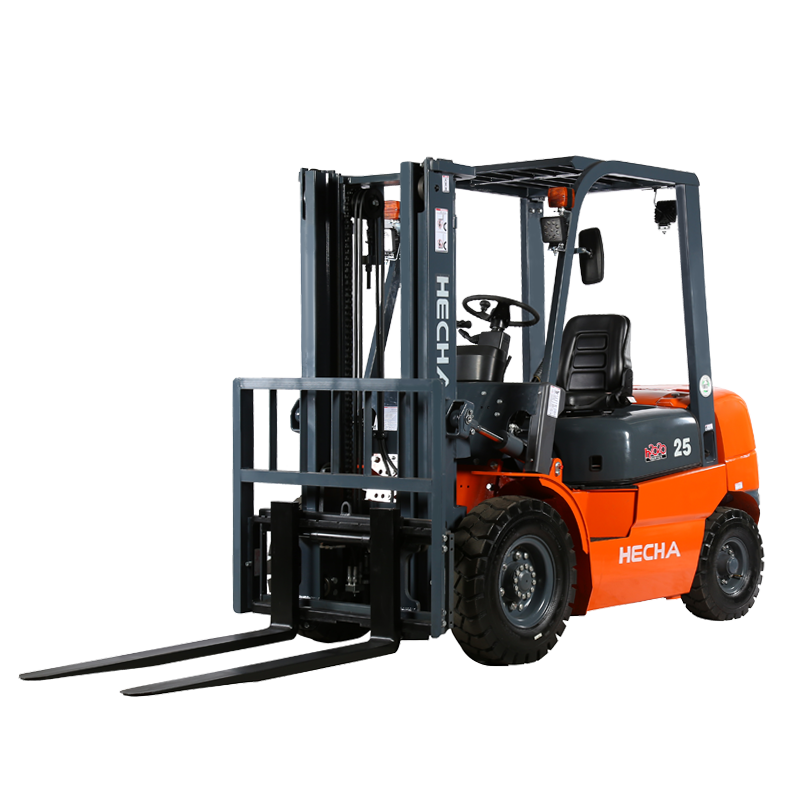 Hecha 2.0–3.8 Ton Diesel Forklift for Mid-Range OperationsPart of Hecha's H-series 1.5–5 ton range, the FD20–FD35 models target mixed indoor-outdoor work where payload and fuel use need balancing.View Product →
If you regularly move 8–10 ton loads, a heavy-duty diesel forklift will consume more per hour but can replace two smaller trucks. That changes the fuel math entirely. A single 8-ton truck at 8 L/h may use less fuel than two 4-ton trucks at 5 L/h each for the same total tonnage.
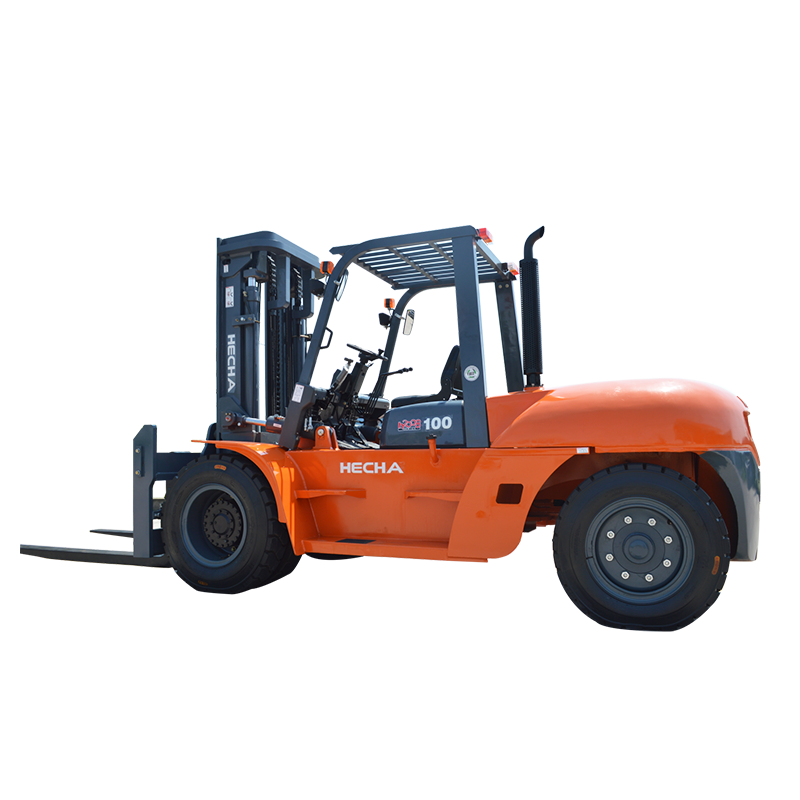 8–10 Ton Heavy-Duty Diesel Forklift for Port and Industrial LogisticsFor regular 8–10 ton loads, this counterbalance series includes FD50–FD120 models with 5,000–12,000 kg capacities for port, warehouse, and industrial handling.View Product →
Always request a fuel consumption test or reference from a similar application. A reputable manufacturer will provide honest numbers rather than a single optimistic figure.
Frequently Asked Questions
Q1: How many liters per hour does a diesel forklift use?
Most 2–3 ton diesel forklifts use 2.5–4.5 L/h depending on load and terrain. A 5-ton truck typically uses 5–7 L/h, and a 10-ton truck can use 10–13 L/h at high load.
Q2: Does load weight change fuel consumption?
Yes. Fuel consumption increases roughly linearly with load. Lifting 2 tons instead of 1 ton can increase hourly fuel use by 30% or more. Attachments add dead weight and further raise consumption.
Q3: Is diesel cheaper to run than LPG?
It depends on local fuel prices. Diesel usually has higher torque and lower purchase price, but LPG often costs less per hour and produces fewer emissions. For indoor or mixed use, LPG can be more economical overall.
Q4: How can I measure fuel consumption on my own forklift?
Fill the tank to a marked level, record the hour meter, operate for a full shift, then refill to the same level. Divide liters used by hours operated. Repeat over several days for a reliable average.
Q5: What is the typical fuel consumption for a 3-ton diesel forklift?
A 3-ton diesel forklift typically consumes 2.5–3.2 L/h at 50% load and 3.5–4.5 L/h at 75% load. Idling, rough terrain, and heavy attachments can push consumption higher.
Diesel forklift fuel consumption is not a fixed number. It is a range shaped by load, engine condition, terrain, and operator behavior. Start by measuring your current liters per hour, then compare that baseline to the ranges in this guide. Small changes—less idling, better maintenance, and the right truck size—can cut fuel costs by 10–20% without sacrificing productivity. If you are specifying a new truck, ask for consumption data at your actual duty cycle, not a brochure figure. That is the only number that matters for your budget.