English
 中文简体
中文简体 русский
 Français
 Español

Understanding the Role of a Reach Truck in Modern Warehousing
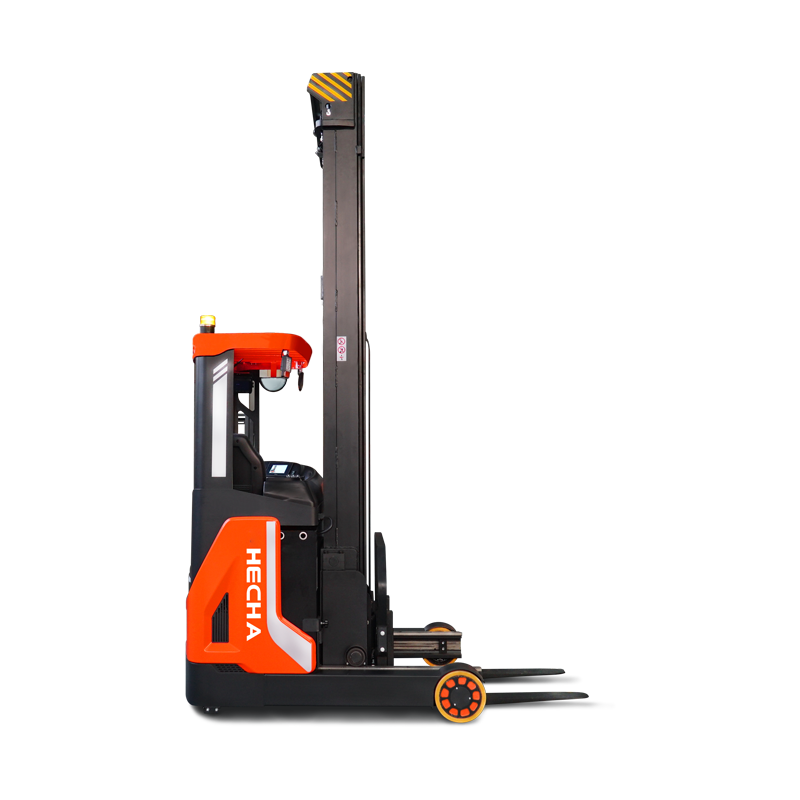
Warehouse footprints are expensive, and every square foot of unused vertical space represents lost storage capacity. A reach truck was engineered specifically to solve this problem. Unlike a counterbalance forklift, which needs wide aisles to turn and maneuver, this equipment class uses a pantograph or scissor-reach mechanism that extends the forks forward to pick or place a load, then retracts them close to the mast for travel. This design allows the truck itself to remain compact while still reaching deep into a rack bay.
The result is a machine that can operate in aisles roughly 8 to 10 feet (2.4 to 3 meters) wide, compared to 12 feet (3.6 meters) or more required by traditional counterbalance trucks. In facilities where every additional foot of aisle width removes a full rack row, that difference translates directly into usable pallet positions.
Why Narrow Aisle Optimization Matters for Storage Density
Vertical space is almost always more available than horizontal space in an existing building envelope. Raising rack height from 20 feet to 30 feet without expanding the building footprint can add close to 50 percent more storage positions, but only if the material handling equipment can safely and precisely place loads at that elevation.
This density gain is not simply a matter of squeezing racks closer together. It requires equipment that can lift loads accurately at height while operating in a confined footprint, and it requires floor conditions, guidance systems, and operator training that match that precision requirement.
How the Reach Mechanism Works
The defining feature of this equipment category is the extending carriage. When the truck approaches a rack opening, the mast and wheelbase stay stationary while a scissor or pantograph linkage pushes the forks forward into the bay. Once the load is picked or set down, the mechanism retracts the forks back over the wheelbase, shortening the truck's overall length for travel through the aisle.
This reach-and-retract motion is what allows the truck's chassis to remain narrower than a comparable counterbalance model. Because the counterweight and wheelbase never need to swing wide to reach a pallet position, the aisle only needs to be wide enough for the truck body plus a small clearance margin, not wide enough for a full turning radius at the rack face.
Reach Truck vs Order Picker vs Standard Counterbalance Forklift
Selecting the right equipment depends on load type, pick pattern, and rack configuration. The table below outlines how three common warehouse lift categories compare on the factors that matter most for narrow aisle planning.
| Attribute | Reach Truck | Order Picker | Counterbalance Forklift |
|---|---|---|---|
| Typical Aisle Width | 8-10 ft | 6-8 ft | 12+ ft |
| Maximum Lift Height | Up to 30-36 ft | Up to 30 ft | Up to 20 ft |
| Primary Task | Full pallet handling | Case or piece picking | Bulk handling, loading docks |
| Operator Position | Standing, elevating cab optional | Elevating with operator | Seated |
| Best Fit | High-density pallet racking | Split-case fulfillment | Yard, dock, mixed-use floors |
Many distribution centers combine two or more of these categories in a single facility: a narrow aisle forklift handles pallet-in and pallet-out movement within the racking, while order pickers handle piece-level fulfillment at lower levels and counterbalance units manage trailer loading at the dock.
Key Design Features That Enable High-Reach Performance
Several engineering elements work together to make safe, precise operation at height possible in a compact footprint.
- Outrigger or straddle base: Legs extend beneath the pallet load to provide stability without adding counterweight bulk to the rear of the truck.
- Multi-stage mast: Telescoping mast sections allow full extension to high rack levels while collapsing to a manageable height for indoor clearance and overhead obstructions.
- Fork-side or rear-mounted battery compartment: Keeps the center of gravity balanced as loads shift position during the reach cycle.
- Wire or rail guidance compatibility: Many units can be fitted with guidance systems that keep the truck centered in very narrow aisles without constant manual steering correction.
- Elevated or free-lift cameras and sensors: Give the operator a clear view of the fork tips and load placement at heights where direct sightlines are limited.
Mast Configuration Options
Mast selection is one of the most consequential decisions in a narrow aisle equipment specification, because it determines both maximum reach and the truck's lowered travel height.
| Mast Type | Best For | Trade-off |
|---|---|---|
| Simplex | Low-bay storage under 12 ft | Limited lift height |
| Duplex | Mid-height racking, mixed environments | Moderate collapsed height |
| Triplex | High-bay racking above 20 ft | Requires careful overhead clearance planning |
Reach Truck Operator Safety Best Practices
Most narrow aisle incidents are not caused by equipment failure. They come from a mismatch between aisle conditions, load weight, and operator awareness at height.
Because these trucks routinely operate at elevations well above the operator's own vantage point, safety protocols differ from those used with standard forklifts. Facilities running high-reach operations typically enforce the following practices:
- Conduct a pre-shift inspection of the mast chains, hydraulic lines, and reach carriage before every shift, not just daily.
- Maintain floor flatness within manufacturer tolerance, since uneven floors amplify mast sway at full extension.
- Require seatbelt or restraint use even on stand-up models equipped with an operator harness point.
- Set speed limits that reduce automatically when the mast is raised above a threshold height.
- Use overhead guard rating appropriate to the racking height and any overhead conveyor or sprinkler infrastructure.
- Train operators specifically on load center calculations, since rated capacity drops as the load is extended forward and lifted higher.
Warehouse Vertical Space Maximization: Layout Considerations
Converting an existing facility to narrow aisle operation is a layout exercise as much as an equipment purchase. The diagram below illustrates the difference in usable footprint between a wide-aisle and narrow-aisle rack layout covering the same floor area.
Within the same total footprint, narrowing the aisle by roughly a third made room for an additional rack row. This kind of gain is why many facilities pursue narrow aisle optimization before considering building expansion.
Floor and Guidance Requirements
Tighter aisles reduce the margin for steering error, so floor flatness and guidance systems become more important as aisle width decreases.
| Aisle Width | Guidance Recommendation | Floor Flatness Tolerance |
|---|---|---|
| Above 10 ft | Manual steering acceptable | Standard commercial slab |
| 8-10 ft | Optional rail or wire guidance | Tighter flatness class recommended |
| Below 8 ft | Guidance system generally required | Superflat or defined-movement floor |
Selecting the Right Reach Truck for Your Facility
Choosing between reach truck models comes down to matching lift capacity, mast height, and battery configuration to actual pallet weights and rack elevations, rather than defaulting to the highest-specification unit available.
- Confirm maximum pallet weight at the highest storage level, since rated capacity decreases with lift height and forward reach.
- Measure actual aisle width at the narrowest point, including any protruding rack uprights or sprinkler risers.
- Check overhead clearance for collapsed mast height plus overhead guard, particularly under mezzanines or conveyor lines.
- Evaluate duty cycle to determine whether a standard battery, opportunity charging, or lithium-ion power source fits shift patterns.
- Plan for operator visibility at height, adding camera or sensor packages where sightlines to the fork tips are obstructed.
Maintenance and Long-Term Performance
Because a stand-up forklift built for narrow aisle work carries more moving components in the mast and reach mechanism than a standard counterbalance unit, maintenance intervals tend to be shorter and more component-specific.
| Component | Inspection Interval | Common Wear Point |
|---|---|---|
| Mast Chains | Weekly | Elongation, lubrication |
| Reach Carriage Rollers | Monthly | Flat spots, misalignment |
| Hydraulic Hoses | Monthly | Cracking, fluid leaks |
| Battery Connections | Weekly | Corrosion, loose terminals |
Facilities that log inspection data against usage hours, rather than relying on calendar-based schedules alone, tend to catch chain elongation and roller wear before they affect placement accuracy at height.
Frequently Asked Questions
Q1: What is the main difference between a reach truck and a standard forklift?
A reach truck uses an extending fork carriage that allows the truck body to stay compact while the forks reach into the rack bay, enabling operation in narrower aisles than a standard counterbalance forklift requires.
Q2: How narrow can a warehouse aisle be with this equipment?
Many facilities operate aisles between 8 and 10 feet wide, though the exact minimum depends on truck model, load dimensions, and whether guidance systems are installed.
Q3: Do narrow aisle trucks require special floor conditions?
As aisle width decreases and guidance systems are introduced, floor flatness tolerances typically become stricter to keep the truck properly aligned with the rack face at height.
Q4: How does load capacity change at maximum lift height?
Rated capacity generally decreases as the load is lifted higher and extended further forward, so operators should always reference the truck's capacity chart for the specific height and load center in use.
Q5: Can one truck handle both pallet storage and case picking?
Some configurations are adaptable, but most facilities pair a reach truck for full pallet movement with a separate order picker for piece or case-level fulfillment, since the two tasks call for different platform and visibility designs.