English
 中文简体
中文简体 русский
 Français
 Español

Executive Summary
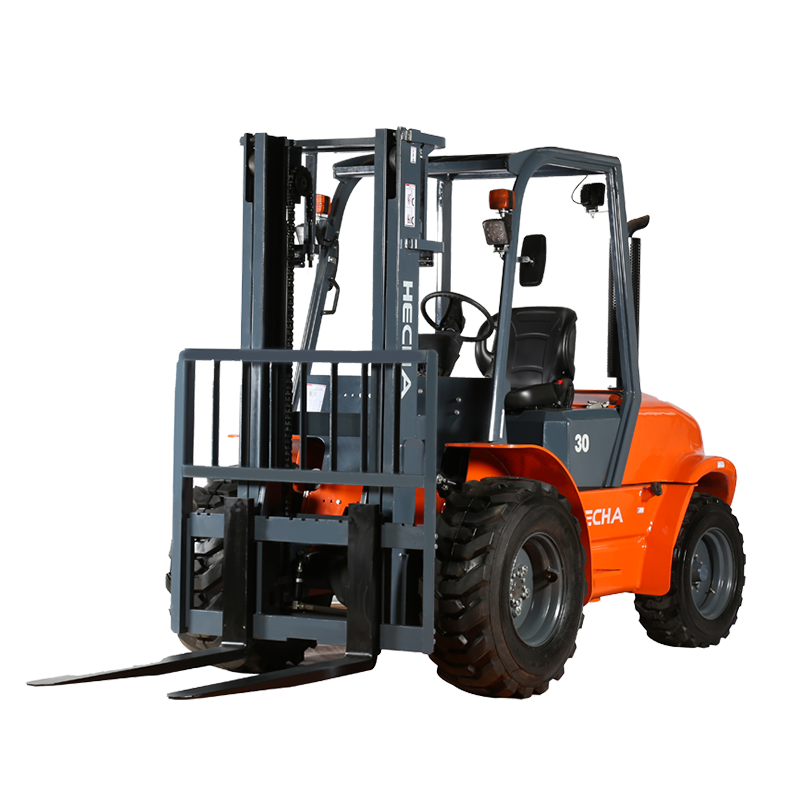
The heavy-duty handling of uneven surfaces in industrial, construction, agricultural and logistics operations increasingly depends on specialized material handling systems. Among these, the 2WD rough terrain forklift and its four-wheel-drive counterpart have distinct technical characteristics that affect mobility, traction, power distribution, stability and systems integration.
Industry Background and Application Importance
Rough terrain forklifts are specialized lift trucks designed to operate on uneven, unpaved, and variable ground conditions prevalent in construction sites, mining yards, agricultural fields, and rural logistics nodes. Historically, traditional industrial forklifts were optimized for flat, prepared concrete or asphalt surfaces; but the demand for material handling in unconventional field conditions has driven the development of rough terrain variants.
Operational Environments
- Unpaved Surfaces: Gravel, compacted dirt, soft soil, and mixed terrain.
- Gradient and Incline: Sloped embankments and irregular grade changes.
- Dynamic Load Conditions: Load shifts due to uneven surfaces require adaptive stability control.
- Large Footprints: Wide work zones with intermittent obstacles.
In these settings, mobility and traction are paramount. The 2WD rough terrain forklift is often selected for applications requiring simpler mechanical systems and lower acquisition cost, whereas four-wheel-drive systems aim to support more demanding traction scenarios.
Industry Core Technical Challenges
Rough terrain material handling introduces several system-level challenges:
1. Traction and Ground Engagement
Maintaining traction on loose or shifting surfaces is fundamental. Surface irregularity and wheel slip directly impact the capability to accelerate, brake and maneuver under load.
- Tire Interaction: Tire design, contact patch modulation and surface compliance vary with terrain.
- Slip Regulation: Without proper slip control, wheels may spin or bog down.
2. Power Distribution Architecture
The mechanical and hydraulic distribution of engine power influences both traction and load-handling capability.
- 2WD Systems: Typically deliver engine torque to two driving wheels, requiring traction compensating designs.
- 4WD Systems: Distribute torque symmetrically across all wheels, increasing traction redundancy but at greater mechanical complexity.
3. Stability Under Load
Lift trucks dealing with heavy loads must maintain center-of-gravity stability while navigating uneven ground.
- Load Dynamics: Lateral stability is compromised when one wheel loses contact with the ground.
- System Controls: Advanced stability systems (e.g., automatic leveling) are often integral in 4WD platforms.
4. Systems Integration for Sensing and Control
Rough terrain operation benefits from integrated sensing and control systems that monitor wheel slip, pitch, roll, and engine performance.
- Sensor Networks: Wheel speed, torque output and terrain feedback must be integrated in real time.
- Control Algorithms: Precision in torque modulation minimizes energy waste and unscheduled maintenance.
Key Technical Pathways and System-Level Solution Approaches
Understanding the differences between 2WD and 4WD rough terrain forklifts requires a systems-level view of drivetrain architecture, control strategies, and integration with chassis dynamics.
Drivetrain Architecture
2WD Drivetrain:
- Engine connects to a differential that supplies torque to two primary drive wheels.
- Steering and drive functions are distinct; steering may be hydraulic or mechanical.
- Simpler geartrain and fewer moving parts reduce system weight and frictional losses.
4WD Drivetrain:
- Engine torque is split through a transfer case to both front and rear axles.
- Each axle has a differential; some architectures include limited-slip or locking differentials.
- Requires more robust bearings, shafts, and seals due to increased torque paths.
Traction Control
| Aspect | 2WD Rough Terrain Forklift | 4WD Rough Terrain Forklift |
|---|---|---|
| Traction Availability | Limited to two wheels | Available at all four wheels |
| Slip Control Complexity | Less complex | Higher, with potential for individual wheel modulation |
| Mechanical Complexity | Lower | Higher |
| Weight | Lower | Higher |
| Cost (System) | Lower | Higher |
| Redundancy | Minimal | Significant |
| Hill Climb Capability | Moderate | Enhanced |
This table underscores intrinsic differences in traction capability and mechanical design trade-offs.
Control Systems Integration
While both 2WD and 4WD platforms benefit from electronic control units (ECUs), the level of integration differs:
- 2WD Systems: May use simpler slip detection and throttle response strategies to mitigate wheel spin.
- 4WD Systems: Frequently incorporate more sophisticated torque vectoring, differential lock control, and terrain-adaptive modes.
Typical Application Scenarios and Architecture-Level Analysis
Construction Sites
Construction environments present irregular terrain with intermittent surface changes. Material handling tasks include lifting palletized supplies, placing heavy components, and clearing debris.
- 2WD Forklift Use Case: Suitable for tasks on relatively compacted dirt or gravel where traction demand is moderate.
- 4WD Forklift Use Case: Preferred where surface conditions are loose or soft, requiring enhanced traction and stability.
From an architectural perspective, 4WD systems allow greater force distribution, maintaining traction even when one or more wheels lose surface contact.
Agricultural Fields
Agricultural terrain presents soft soil, mud, ruts and variable moisture conditions. Payloads might include feed, equipment or harvested produce.
- 2WD Deployment: Works adequately in dry, firm field sections.
- 4WD Deployment: Offers higher operational uptime in wet or loamy soils.
In this use case, torque distribution and slip control become critical system parameters, impacting cycle time and fuel efficiency.
Logistics Yards and Intermodal Terminals
In logistics yards with unpaved sections, the requirement is often rapid maneuvering and lateral stability.
- 2WD Architecture: May achieve adequate performance for lighter loads and short travel distances.
- 4WD Architecture: Improves predictability in load handling across varied surface irregularities.
At the systems architecture level, the inclusion of real-time sensing modules (e.g., wheel speed monitors) enhances operational smoothness in 4WD platforms.
Technical Solutions and Their Impact on System Performance, Reliability, Efficiency, and Maintenance
Performance
Traction and maneuverability are directly influenced by drivetrain design. 4WD architectures deliver broader traction performance envelopes, enabling operation over a wider range of surface conditions without excessive operator intervention.
Acceleration and hill climb capability are improved with 4WD systems due to more balanced torque delivery, though this comes with increased drivetrain complexity and inertia.
Reliability
2WD systems offer reliability advantages by virtue of fewer mechanical components and simpler power paths. Fewer moving parts correlate with:
- Lower mechanical wear points
- Simplified maintenance routines
- Reduced likelihood of torque path failures
Conversely, 4WD systems, while offering performance benefits, require rigorous sealing, lubrication and monitoring strategies to maintain longevity in harsh environments.
Energy Efficiency
- 2WD Configurations: Tend to be more energy-efficient in applications where four-wheel traction is unnecessary, due to lower mechanical drag.
- 4WD Configurations: Consume more energy due to additional torque pathways and heavier system weight, but can be more efficient on difficult terrain by reducing slip losses.
Operational and Maintenance Considerations
Maintenance strategies diverge notably:
- 2WD Platforms: Routine checks focus on drive wheel assembly, differential service, and steering subsystem integrity.
- 4WD Platforms: Maintenance expands to transfer cases, additional differentials, locks or limited-slip systems, and integrated sensors. Diagnostic routines often leverage onboard ECUs and telemetry.
Industry Development Trends and Future Technical Directions
The rough terrain forklift segment continues evolving under several systemic pressures:
Electrification
Although internal combustion power remains dominant, electrification for rough terrain platforms is advancing due to:
- Battery energy density improvements
- Electric motor torque responsiveness
- Lower acoustic and emission footprints
Engineering challenges include thermal management, energy storage packaging for ruggedized frames, and maintaining high torque at low speeds.
Predictive Diagnostics
Integrated sensor systems and data analytics are increasingly used for:
- Predictive maintenance
- Fault identification
- Component lifetime forecasting
This trend drives deeper systems integration between drive controls, hydraulics and telematics subsystems.
Adaptive Traction Control
More advanced algorithms that adapt to real-time terrain feedback are being explored, supporting:
- Intelligent wheel torque vectoring
- Automated differential locking strategies
- Load-aware drive modulation
Modular Architectures
Modularity benefits maintenance, upgradeability and customization. Systems engineering approaches increasingly emphasize modular drivetrain and control clusters to support diverse deployment needs.
Summary: System-Level Value and Engineering Significance
This comparison between 2WD rough terrain forklift and 4WD systems reveals:
- Fundamental architecture differences that affect traction, stability, energy efficiency and integration complexity.
- System-level trade-offs between simplicity and performance envelope breadth.
- Applicability domains where each configuration provides operational sufficiency.
For engineers, technical managers and system integrators, understanding these differences enables more informed decisions about platform selection, systems design and lifecycle planning—especially in applications where terrain variability and load handling demands are significant.
FAQ
Q1: When is a 2WD rough terrain forklift sufficient for field operations?
A1: A 2WD platform may be sufficient where surfaces are relatively firm and consistent, gradients are moderate, and operational cycles do not require high traction redundancy.
Q2: Does 4WD improve operator safety?
A2: 4WD systems can improve stability in variable terrain conditions by distributing traction and reducing wheel slip, which can indirectly enhance safety during load transfer and maneuvering.
Q3: How do maintenance costs compare between 2WD and 4WD systems?
A3: Maintenance costs for 4WD systems can be higher due to additional mechanical components (e.g., transfer case, differentials) and more complex control systems.
Q4: Can electric powertrains be used with rough terrain forklifts?
A4: Yes, electrification is technically feasible and increasingly explored, but it requires careful systems engineering to address thermal management, energy density and robustness under variable loads.
Q5: Are there specific control systems that benefit both 2WD and 4WD platforms?
A5: Integrated traction control, real-time terrain sensing and adaptive torque modulation benefit both configurations, improving efficiency and reducing slip-related energy loss.
References
- Technical literature on rough terrain drivetrain architectures and torque distribution strategies.
- Systems engineering textbooks on traction control and stability in off-road vehicles.
- Industry standards on material handling equipment safety and performance evaluation.